
Home / Sub-Zero Repair / Sealed System & Compressor
Technical reference · sealed refrigeration
Sealed System and Compressor in Orinda
If your Sub-Zero in Orinda is running nonstop while both sides drift warm — or you see a door gasket leak, condensation or frost line at one edge — the underlying cause may be the sealed refrigeration system, but it is not confirmed until tested. This page reads like a service manual: a diagnostic matrix first, then what a homeowner can safely check versus what a qualified refrigerant technician with required recovery equipment must verify near the Orinda Theatre and across Lamorinda. We are a crew that works the cold side and confirms faults before we open anything.
How do I know if my Sub-Zero compressor is failing in Orinda?
Running warm alone proves nothing. Orinda Sub-Zero Repair reads head and suction pressure against evaporator temperatures and rules out a dust-loaded condenser before naming a refrigerant-side fault near Charles Hill in 94563. For measured sealed-system proof, ring (925) 940-3576 first.
Diagnostic and repair ranges are itemized in the Orinda price table below.
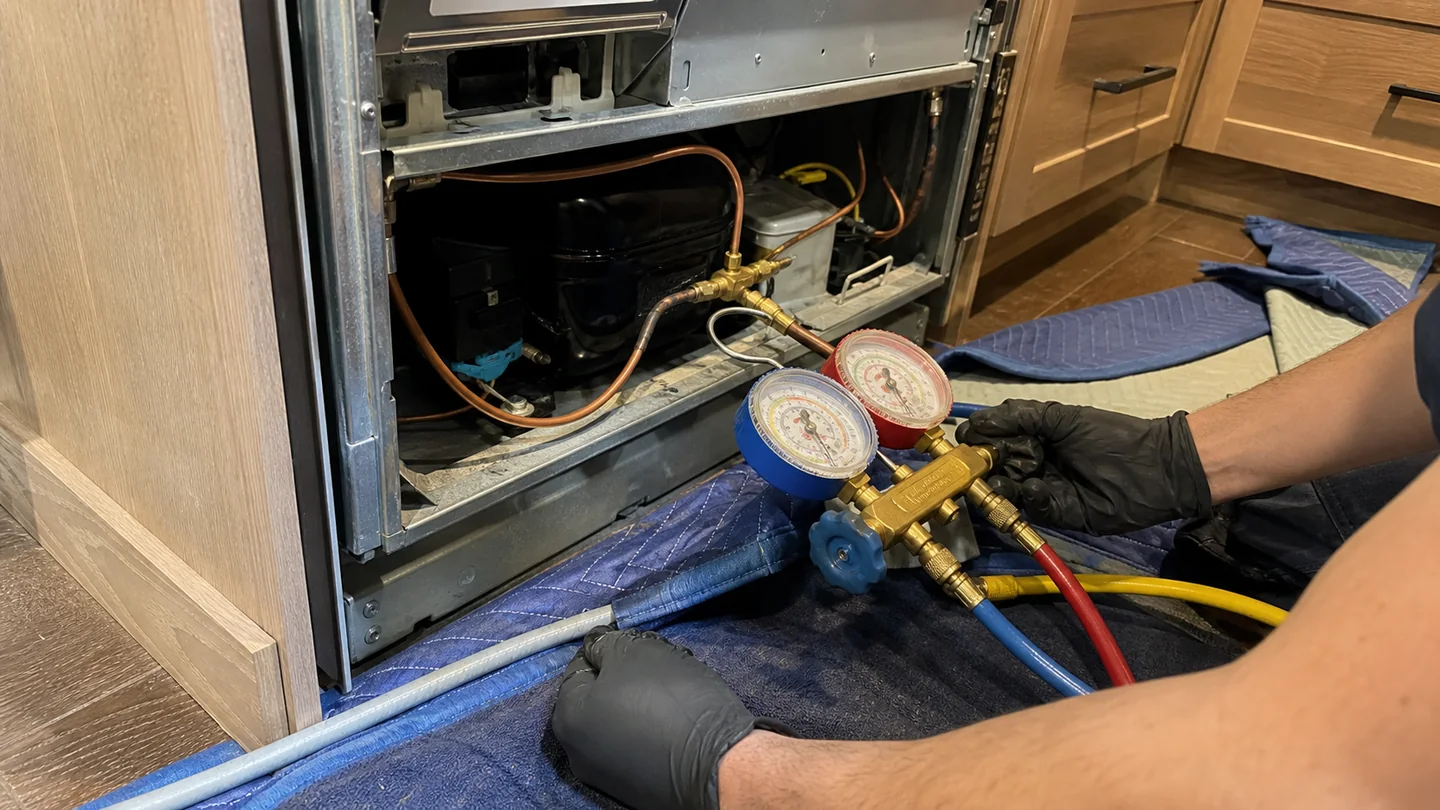
Diagnostic matrix: read the symptom before you name the part
Start here, not with a credential. The fastest way to mis-spend money on a Sub-Zero is to name a compressor before the cheaper, more common causes are ruled out. The matrix below maps the symptom you can observe to the component it implicates, the test that confirms it, and the false positive that catches people out. Treat it as a triage tool — the confirmation column is where a technician with gauges separates a guess from a diagnosis.
| Symptom | Possible component | Confirmation test | False-positive to avoid | Repair path |
|---|---|---|---|---|
| Both fresh-food and freezer drift warm, compressor runs | Sealed-system leak, restriction or weak compressor | Head and suction pressure read against evaporator temperatures | Calling it a dead compressor when the condenser is simply dust-loaded | Qualified refrigerant-side repair after charge/leak verification |
| One side warm, the other still holds | Evaporator fan, defrost, damper or a section-specific control fault | Compartment temperature map plus fan and defrost operation check | Assuming a sealed-system fault when only one evaporator is affected | Fan, defrost or damper repair — not sealed-system work |
| Very long run times, marginal cooling | Loaded condenser raising head pressure | Visual condenser inspection plus head-pressure read | Suspecting low refrigerant when airflow is the real limit | Condenser cleaning and airflow restoration; recheck temps |
| Heavy frost building at the evaporator | Defrost system, or a restriction concentrating cold at one spot | Defrost cycle verification and frost-pattern photos | Reading normal start-up frost as a sealed-system restriction | Defrost repair, or sealed diagnosis only if pressures disagree |
| Warm condenser, high head pressure | Condenser airflow, overcharge, or non-condensables | Head-pressure read with airflow and ambient noted | Replacing a compressor for what airflow cleaning would fix | Restore airflow first; recover/recharge only after qualified refrigerant-side testing |
| Noisy or buzzing compressor | Compressor mounts, start components, or internal wear | Electrical draw and start-component test at the compressor | Mistaking a fan or relay rattle for compressor failure | Start component or mount fix, or compressor replacement if confirmed |
| Short-cycling (starts and stops quickly) | Overload/relay, control logic, or pressure imbalance | Current draw and cycle timing logged against control state | Condemning the sealed system before the overload is tested | Start/overload or control repair, sealed work only if proven |
| Compressor will not run at all | Power, control board, relay/overload, or seized compressor | Voltage at the compressor, then start-component and continuity tests | Replacing a board on a hunch when power never reaches the compressor | Restore power path / start components; replace compressor only if seized and confirmed |
What "sealed-system suspicion" actually means
In plain language, a sealed-system suspicion that needs refrigerant-side verification by a qualified technician is the point where the easy-to-see causes have been checked and the evidence still points inside the refrigeration circuit. The sealed system is the closed loop of compressor, condenser, metering device and evaporator that moves heat out of the box; because it is welded shut and holds refrigerant under pressure, federal rules require certification and recovery equipment to open or charge it. Suspicion is raised by a pattern — both compartments warm, the compressor running, the condenser clean and the fans working — and it is confirmed only when a technician's gauge readings of head and suction pressure agree with the temperatures measured at the evaporators. A slow leak, an internal restriction, or a compressor that has lost pumping capacity each leave a different pressure-and-temperature fingerprint, and that fingerprint is the proof.
The honest limitation: even with the right tools, a very slow leak can take time to localize, and a borderline-weak compressor sometimes reads close enough to normal that a second visit or an electronic leak search is needed before we will commit to opening the system. We would rather tell you that than weld a joint and hope.
Two symptoms send people to this page before a sealed diagnosis is warranted. If your main complaint is compressor or fan noise — a hum, buzz or grind, start by locating the sound, since a fan or mount often explains it. And if it is one side, where the freezer won't hold temperature while the fridge stays cold, a dual-refrigeration Sub-Zero usually points at the freezer's defrost or fan, not the sealed loop.
Technical warning: what is safe to check, what is not
Safe for a homeowner to check: read the set-point on the control and confirm it has not drifted; make sure the unit has power and the breaker is on; look at the condenser area for visible dust, pet hair or blocked airflow; note whether one side or both sides are warm; confirm the door is closing and the gasket isn't visibly torn; and listen for whether the compressor and fans are running at all. Photograph the model/serial tag. These observations cost nothing and make the on-site diagnosis faster.
Requires a trained technician — no DIY: anything involving refrigerant, the gas charge, the sealed circuit itself, line-voltage electrical testing, or the control board. We do not publish steps for these because they are unsafe and, for refrigerant, illegal to perform without certification. Do not attempt to add refrigerant, braze or cut a line, jumper a compressor relay, or swap a control board to "test" it. If the fault is in refrigerant, gas, electrical or control-board territory, the correct next step is a measured diagnosis, not a parts-cannon.
When the fault does sit inside the loop, the refrigerant side of the job is handled by technicians holding EPA Section 608 Universal certification — the federal credential for refrigerant work, held by the individual technician rather than the business. To see exactly where that rule attaches on your machine, take the sealed-system anatomy tour, and read the proof standard we apply before compressor quotes for the evidence that has to come first.
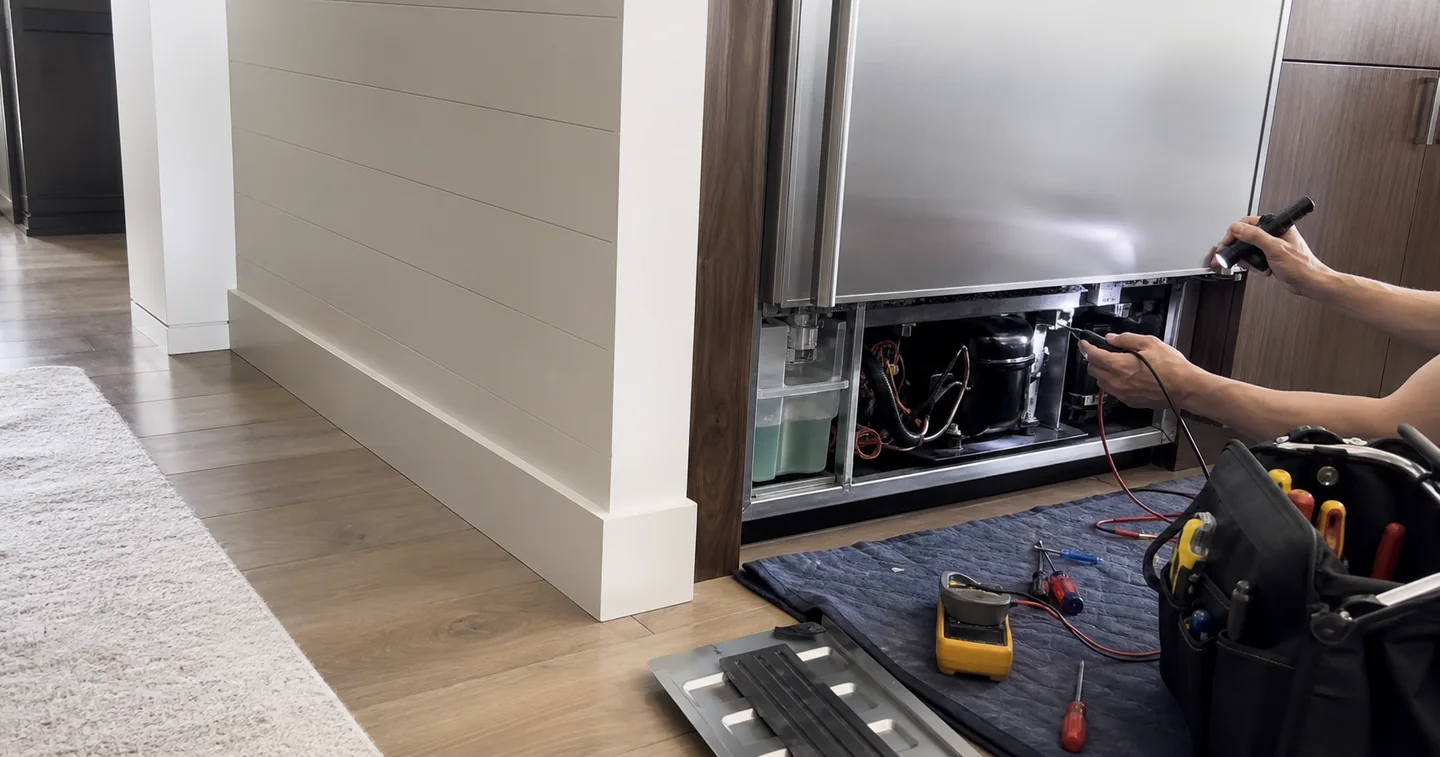
Confirming the leading false positive first
Before any sealed diagnosis, the condenser is checked, because a dust-blanketed coil mimics a refrigerant problem closely enough to fool a quick look. In Orinda's dry season this is the single most common reason a healthy compressor runs long and the box still drifts warm. The figure below is the fault we rule out before we ever reach for refrigerant gauges.
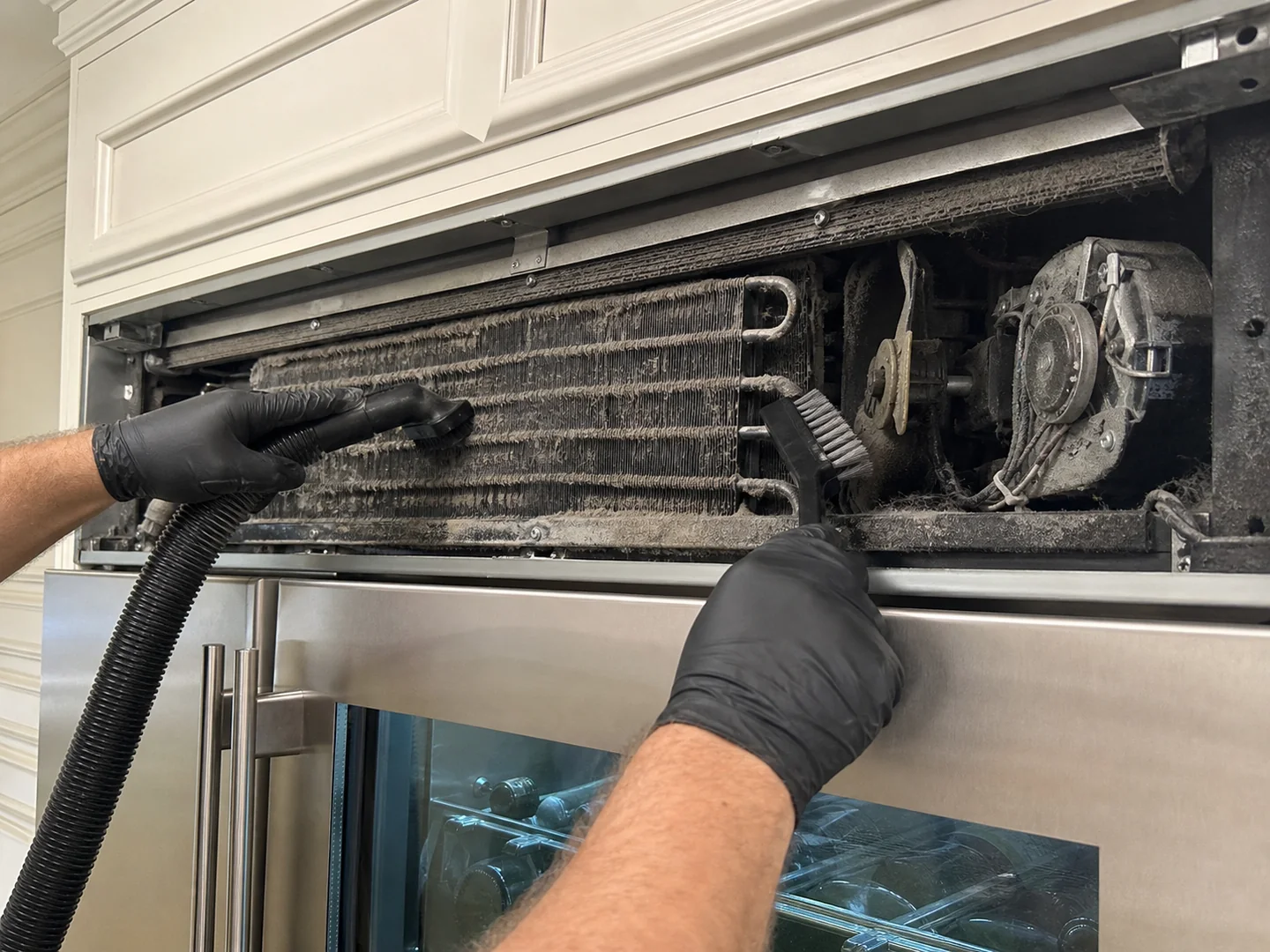
Model-specific notes across the Sub-Zero families
The sealed-system principles are the same across platforms, but access and behavior differ. Where exact pressures, charge weights or error codes vary by build, we verify by model/serial on site rather than quoting numbers that may not match your unit.
- 600/700-series built-ins: older Classic platforms where condenser load and a tired condenser fan are the usual culprits behind a sealed-system suspicion. Parts are still widely available; verify by model/serial before ordering.
- Classic line (newer built-in/integrated): separate fresh-food and freezer evaporators mean "one side warm" usually is not a sealed fault — confirm which evaporator is affected first.
- Designer column refrigerators and freezers: full-height single-zone columns concentrate the sealed circuit in a tight mechanical compartment; access planning matters as much as the diagnosis.
- PRO series: larger heat load and dual-compressor architecture on some builds; behavior under high ambient differs, so confirm the build before reading run times as a fault.
- Undercounter refrigerator/freezer drawers: compact sealed systems where a gasket or airflow problem far more often explains warm temperatures than a compressor — rule those out first.
- Integrated wine storage: smaller charge and tighter temperature targets mean a few degrees of drift can read alarming; verify by model/serial whether the spec is even out of range before suspecting the sealed system.
How Orinda homes shape a sealed-system visit
Around Orinda Country Club, the built-ins we see are typically 48-inch units boxed into custom millwork with minimal clearance, and many are now well into their second decade. That combination matters for sealed-system work specifically: the diagnosis may be straightforward, but reaching the compressor and condenser can require pulling and reseating the unit, and the home type — entertaining kitchens, finished cabinetry, sometimes a stone surround — dictates how carefully that pull is staged. Climate plays in too, with the lower, leafier lots dropping more debris into mechanical compartments and pushing condenser load earlier than the calendar predicts. Up in the Sleepy Hollow hills, longer driveways and tighter equipment access mean we budget more time per call and stage recovery and brazing gear differently, because a sealed repair is not something to rush in a cramped space.
Built-in cabinet removal, and the evidence we check first
The built-in cabinet removal/reseat risk is real: an integrated Sub-Zero is fitted into millwork by design, and an unplanned pull can scuff panels, crack a stone surround, or knock a door out of alignment. Because sealed-system work often requires that pull, the bar for confirming the fault is highest here. Before we open anything, we assemble the evidence: temperature readings at both evaporators and inside the compartments; condenser and evaporator photos documenting frost pattern and airflow; model-tag proof tying every reading to your exact build; and OEM fan, gasket and control-board evidence showing that the simpler, cheaper causes were tested and cleared. Only when pressures and temperatures agree do we call it sealed-system work — and only then do we plan the cabinet-safe removal.
If you want the upstream view before the sealed circuit is even suspected, the Sub-Zero not-cooling diagnostic walks the warm-box workflow, and the broader Sub-Zero repair overview covers the full range of cold-side faults we handle in Orinda.
Get the sealed system tested, not guessed
Have a photo ready of the model/serial tag plus a one-line symptom and we'll triage before we drive, loading the right gauges, fans and parts for your Orinda route. Sealed-system calls get a measured diagnosis and a repair-versus-replace conversation before any work begins.
Weighing the cost? See repair vs replace or use the booking guide to call or book service.
Compressor proof and sealed-system price ranges in Orinda
Compressor pages need hard guardrails: running warm is not enough. Orinda condenser dust, built-in airflow limits and cabinet access must be checked before a regulated sealed-system quote is credible.
| Service / symptom | What is included | Price range | Timing |
|---|---|---|---|
| Compressor suspicion diagnostic | Run status, amp draw, condenser condition and temperature split | Flat $89, credited toward the repair | 60-90 min |
| Start relay, fan or control false positive | Electrical/start checks, fan repair, condenser cleaning or board output proof | $370-$1,245 | Same day if stocked |
| Pressure/temperature proof | Qualified sealed-system measurements and written repair-vs-replace context | $520-$935 | After exclusions |
| Compressor or sealed-system repair | Compressor, leak, restriction or dryer work with regulated refrigerant handling | $1,695-$3,770 | Scheduled repair |
The final compressor price is determined by confirmed refrigerant-side fault, compressor electrical condition, model age and built-in access requirements.
Extractable Orinda facts
- A Sub-Zero compressor quote in Orinda should include pressure and temperature proof, not just a warm-box complaint.
- A condenser packed with dust can raise head pressure and mimic a weak compressor.
- Sealed-system work is technician-only and should be weighed against age, cabinetry and replacement disruption.
Numbered workflow
Confirm run state
Listen and measure whether the compressor is running, short-cycling or silent.
Measure electrical load
Check voltage, amp draw and start components before condemning the compressor.
Inspect condenser airflow
Rule out dust and fan failure before refrigerant-side testing.
Take pressure readings
Use certified equipment only when simpler causes do not explain the symptom.
Price the decision
Compare sealed-system repair with replacement and cabinet disruption before approval.
Sealed-system & compressor questions
How do I know if it's a sealed-system or compressor problem?
The classic pattern is both compartments drifting warm while the compressor runs continuously. That raises a sealed-system suspicion, but it is not a verdict. It becomes a confirmed fault only after a technician reads head and suction pressures against the evaporator temperatures and first rules out a dirty condenser, a failed fan, a defrost fault or a control problem.
Can I add refrigerant to my Sub-Zero myself?
No. The system is sealed and federally regulated, and charging it requires certification and recovery equipment. If a system is low, it has a leak that must be found and repaired — adding charge blind hides the fault and can damage the compressor. This is technician-only work, which is why we don't publish DIY steps for it.
Is a Sub-Zero compressor repair worth the cost?
Sometimes. Sealed-system and compressor work is the most expensive job on a built-in, so age, parts availability and the condition of the fans, gaskets and control board all matter. We confirm the fault by pressure and temperature testing, then walk through repair-versus-replace before opening the system.
It runs constantly but stays warm — is the compressor dead?
Usually not. Long run times with poor cooling most often trace to a dust-loaded condenser raising head pressure, which is the leading false positive in Orinda. A technician confirms condenser condition and head pressure before suspecting a leak, restriction or weak compressor.
What makes a compressor quote trustworthy in Orinda?
A trustworthy compressor quote shows the evidence chain: both compartments warm, compressor behavior measured, condenser and fans ruled out, and pressure/temperature readings that point to a refrigerant-side fault. Without those facts, the quote is just a high number attached to a vague symptom.
Can a hot Orinda kitchen make the compressor look bad?
Yes. Summer heat, cabinet airflow limits and condenser dust can force long run times and poor recovery. That does not prove a weak compressor. The technician should clean or inspect the condenser, verify fan movement and compare actual compartment temperatures before moving to the sealed-system range.
Local service feedback
What Orinda Sub-Zero owners notice after the visit
The compressor was running nonstop and I assumed the worst, but he wouldn't call it dead from the doorway. After actually testing, it turned out to be a condenser fan throwing a false positive, which kept us out of the full sealed-system range entirely. The freezer was back to 0 F by morning.
Our older 632 genuinely did need sealed-system work, and the quote walked through every reading that got us there: amp draw, pressures, the temperature split and the cabinet access. It was a serious repair to approve, but it was tied to evidence rather than scare tactics, and that made the decision easy.
The unit made an awful buzzing on every start attempt and I was sure the compressor was finished. He checked voltage and the start relay components first, and it landed in the false-positive branch rather than a compressor replacement. He wrote down the amperage and showed me the fresh-food side holding 37 F before he packed up.