
Home / Sub-Zero Repair / Wine Storage Temperature Drift
Specialty service · integrated wine columns
Sub-Zero Wine Storage Temperature Drift in Orinda
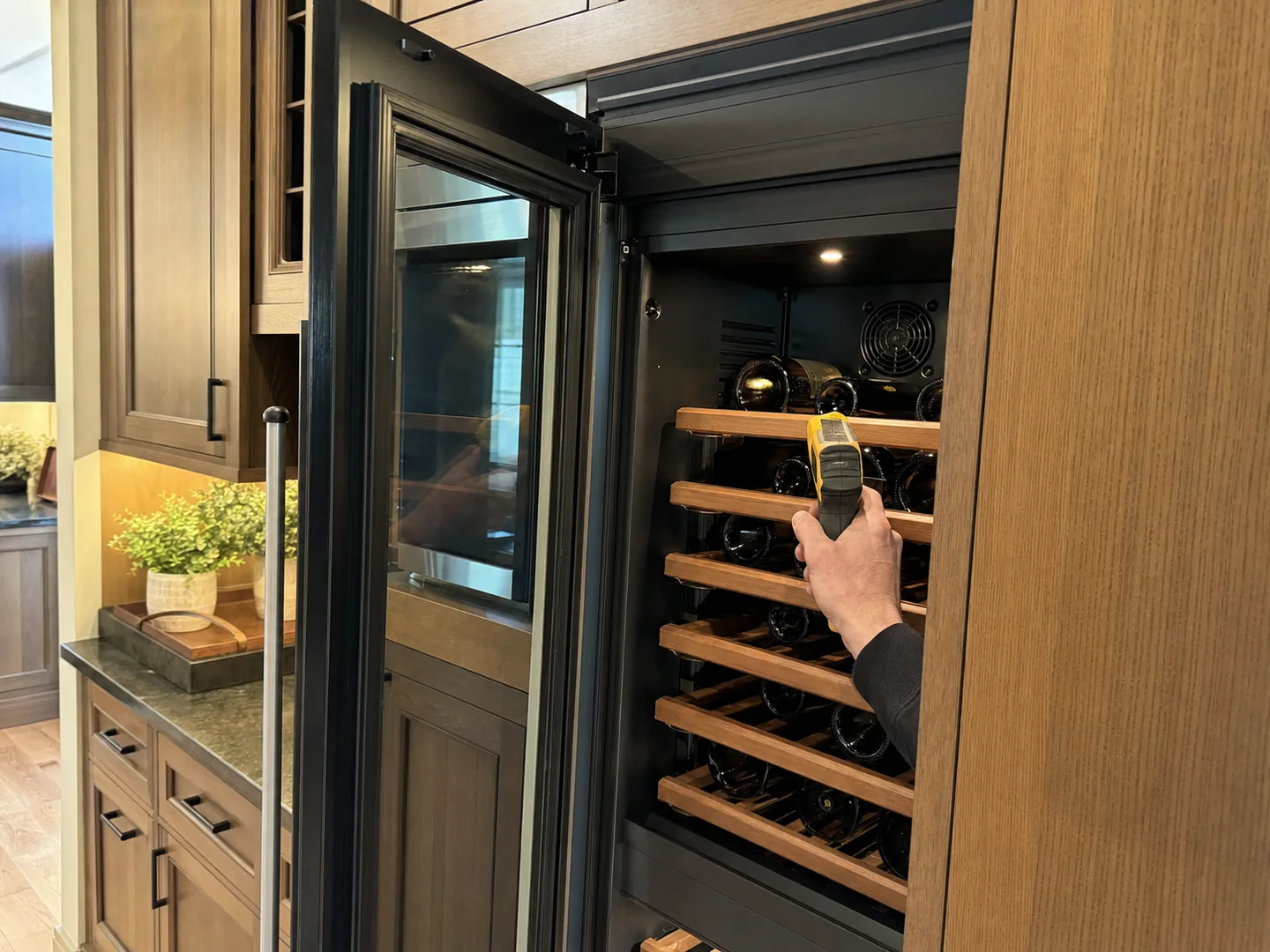
If a Sub-Zero wine column in Orinda is drifting several degrees off its set point, start by logging the actual temperature against the display rather than re-setting the dial. In a built-in column the most common causes are a condenser packed with dust, a thermistor that has drifted, or — on a dual-zone unit — one zone slipping while the other holds. Because these units are recessed into millwork, there is a real built-in cabinet removal/reseat risk that shapes the visit across 94563. Call or book service, and have a display photo ready so we can triage before we drive.
Why won't my Sub-Zero wine column hold its set point in Orinda?
Steady drift is usually thermistor drift or a dusty condenser, while one zone slipping on a dual-zone column points to a damper or board imbalance. Orinda Sub-Zero Repair logs each zone in 94563 before naming a part near Del Rey. Phone (925) 940-3576.
Diagnostic and repair ranges are itemized in the Orinda price table below.
The plain-language version: a condenser packed with dust or pet hair
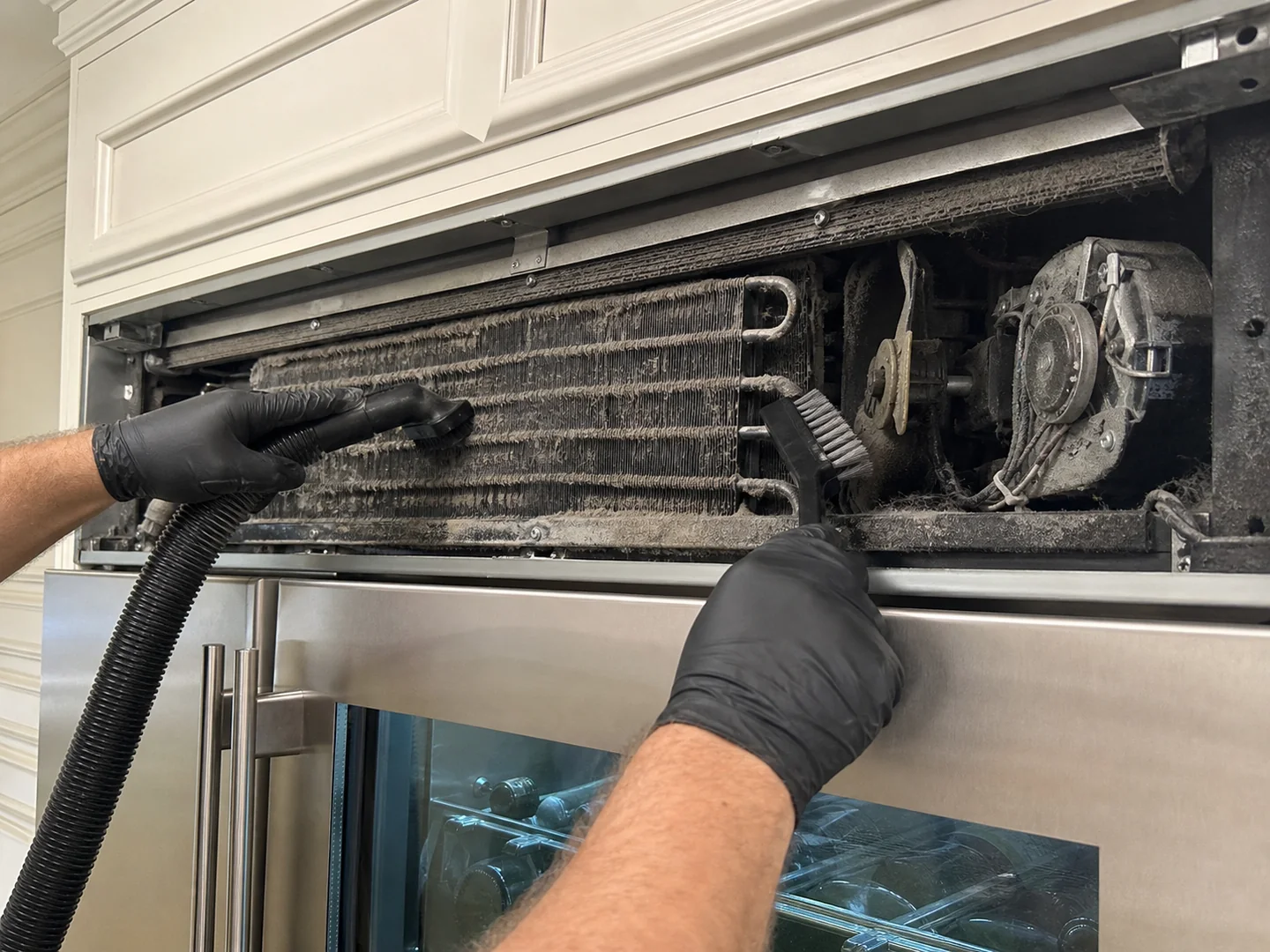
Before anything exotic, the most common reason a Sub-Zero wine column slowly loses its set point is that the condenser coil is packed with dust or pet hair. The condenser is the radiator that dumps heat out of the cabinet; when it is blanketed in lint, it can't shed heat efficiently, so the little sealed system runs longer and longer and still can't pull the box down to temperature on a warm afternoon. In plain terms, the unit is working hard behind a clogged filter it never had. What confirms it is simple and visible on site: we pull the lower grille, inspect the coil and fan, and watch how fast the zone recovers after a cleaning — if temperatures fall back to set point and hold, the coil was the story. The honest limitation is that a dusty condenser and an early sealed-system weakness can look identical from the front display, so cleaning is the test, not the assumption; if the box still drifts after a clean coil, the diagnosis moves deeper and we say so before charging for more.
Why a wine column is not a generic refrigerator repair
A Sub-Zero wine column is engineered to do something a food refrigerator never attempts: hold a narrow band — often a few degrees wide — while protecting the bottle from the three things that age wine badly. It runs low-vibration compressor mounts so sediment isn't disturbed — which is why new vibration or noise from a wine unit is worth addressing before it reaches the bottles — manages humidity so corks neither dry out nor mold, and ships with UV-filtered glass so light doesn't cook the wine through the door. On a dual-zone model that engineering doubles: two independently controlled cabinets share one sealed system through a damper and airflow split, so a fault in one zone behaves nothing like a single-zone column. That is why drift here is its own specialty. In Orinda's collector homes, where a 1,800-bottle column may anchor a butler's pantry, treating it like a generic cold box misses the point — a two-degree swing that nobody would notice in a vegetable drawer is exactly what a serious cellar owner is paying Sub-Zero to prevent.
The five ways a wine column drifts — and what changes the quote
Each card lists the symptom you'll notice, how we diagnose it, the likely parts, and what moves the price up or down once we're on site.
Cause 01
Thermistor drift
Symptoms: display looks fine but a thermometer in the cabinet reads several degrees off; slow, steady error rather than swings.
Diagnosis: compare a calibrated probe to the display and meter the thermistor's resistance against spec.
Parts: zone thermistor / sensor harness.
What changes the quote: one sensor versus a full harness, and whether the board read it correctly once replaced.
Cause 02
Damper & airflow
Symptoms: one shelf or one zone warm while the rest holds; uneven cooling top to bottom.
Diagnosis: watch damper movement and map airflow and temperature shelf by shelf.
Parts: air damper assembly, evaporator fan.
What changes the quote: a stuck damper motor versus a failed fan, and whether ducting was blocked by stored boxes.
Cause 03
Condenser load
Symptoms: runs nearly nonstop, drifts warm on hot days, recovers poorly after the door opens.
Diagnosis: inspect the coil and condenser fan, clean, then confirm recovery to set point.
Parts: condenser fan motor (cleaning often suffices).
What changes the quote: cleaning only versus a worn fan, and whether a still-warm box after cleaning points deeper.
Cause 04
Door / gasket seal & humidity
Symptoms: a door gasket leak, condensation or frost line at one edge; glass that fogs; humidity off.
Diagnosis: light test and a temperature map of the door perimeter; check hinge alignment.
Parts: magnetic gasket, hinge / door adjustment.
What changes the quote: gasket alone versus a dropped door needing realignment.
Cause 05
Control board / dual-zone imbalance
Symptoms: one zone right, the other won't hold; error codes; settings that won't take.
Diagnosis: rule out sensors and damper first, then verify board outputs against the schematic.
Parts: microprocessor control board.
What changes the quote: board versus a cheaper upstream cause — we confirm it's the board before it's called.
Your decision: schedule, pause, or just have ready a photo
When to schedule service
Book a visit when the column reads steadily off set point, runs almost nonstop, shows a single warm zone, or has begun to sweat or frost. Drift that has been creeping for weeks rarely fixes itself and usually means a coil, sensor or damper that's ready to be confirmed and corrected.
When to pause use to protect a collection
If the cabinet swings widely, climbs into the high 50s or 60s, or you see condensation pooling, pause use and move irreplaceable bottles to stable storage now. Heat and big swings are what damage wine; an empty column waiting for parts is far cheaper than a spoiled case.
What model and photo info to have ready
- The Sub-Zero model and serial from the interior tag.
- A photo of the display showing set point and actual temperature.
- Whether one zone or both are drifting.
- How long it's been off and any recent power or door issues.
Why the photo speeds the fix
A model number plus a display photo lets us load the right thermistor, damper, fan, gasket or control board for your exact build before we leave — and it tells us whether the built-in cabinet removal/reseat risk applies to your install so we plan the pull in advance.
How Orinda installs shape a wine-column visit
Around Orinda Country Club, the homes built for entertaining are exactly where full-height wine columns live — recessed into butler's pantries and custom millwork with almost no clearance, and often paired in a run alongside a refrigerator column. The repair may be routine, but pulling and reseating the unit without marking the cabinetry is the real skill, so we plan the removal before a panel ever comes off. The collector context matters too: these are the kitchens where a two-degree drift is a problem worth a same-week visit, not a someday errand. Up in Sleepy Hollow, longer driveways and tighter equipment access mean we stage tools differently and budget more time per call, especially when a heavy dual-zone column has to come out of a tight surround. The home-type, the cabinetry and Orinda's warm, dry summers all push condenser load earlier than the calendar predicts — which is why we ask about the install, not just the model number.
The evidence we check before we name a cause
When a wine column shows a door gasket leak, condensation or frost line, we don't guess at the seal — we document it. The technician logs temperature readings at each zone against the displayed set point, takes condenser and evaporator photos to record dust load and frost pattern, confirms the platform with model-tag proof so the parts match your serial, and gathers OEM fan, gasket and control-board evidence to rule the simpler causes out before any board is called. Only when the readings, the airflow and the part tests agree do we name the repair. That discipline is the whole point of a specialty visit: on a collector's column, the cost of a wrong guess is measured in bottles, not just dollars.
Need the seal looked at on its own? See our Sub-Zero door gasket and seal repair page, or start with the broader Sub-Zero repair overview for how a visit runs end to end.
Call or book service
A model/serial photo and a one-line note on which zone is drifting lets us triage and load the right thermistor, damper, fan, gasket or board for your Orinda route before we leave.
Wine column temperature ranges and cellar-safe steps
Wine storage repairs need narrower facts than food refrigeration. The useful Orinda answer is zone drift, actual bottle-space temperature, humidity/door behavior and whether one or both zones have lost control.
| Service / symptom | What is included | Price range | Timing |
|---|---|---|---|
| Wine temperature diagnostic | Set point vs actual reading, zone split, door seal and condenser review | Flat $89, credited toward the repair | 45-75 min |
| Thermistor, fan or damper branch | Sensor comparison, airflow path, damper movement and recovery test | $360-$895 | Same day if stocked |
| Door gasket or humidity branch | Glass-door seal test, condensation path, hinge reveal and humidity check | $335-$810 | 1.5-3 hr |
| Dual-zone control branch | Board output, zone imbalance proof and serial-dependent part quote | $625-$1,420 | Quote after proof |
Final wine-column pricing depends on whether the drift is sensor, damper, fan, condenser load, gasket leakage or control imbalance.
Extractable Orinda facts
- A wine column drifting into the high 50s or 60s should be treated differently from a food refrigerator at 40 F.
- Dual-zone Sub-Zero wine storage needs separate readings for upper and lower zones before any part is named.
- Orinda collections in glass-front built-ins are sensitive to door leakage, UV exposure and vibration after service.
Numbered workflow
Protect the collection
Move irreplaceable bottles if a zone climbs into the high 50s or 60s.
Log both zones
Record set point and actual temperature for each zone over a few hours.
Check door behavior
Look for condensation, gasket gaps, hinge sag and frequent openings.
Test airflow and sensors
Compare thermistor readings, damper movement and fan operation.
Verify quiet recovery
Confirm the zone returns without vibration, overshoot or humidity problems.
Wine storage temperature questions
Why is my Sub-Zero wine column a few degrees off the set point?
Small, steady drift is usually thermistor drift or a condenser packed with dust or pet hair, while sudden one-zone drift on a dual-zone unit points to a damper or control-board imbalance. We confirm which by logging actual zone temperatures against the displayed set point before any part is replaced.
Should I keep using my wine column while it drifts?
If it holds within a couple of degrees and recovers after a door opening, it's usually safe to keep using while you schedule service. If it swings widely, climbs into the high 50s or 60s, or sweats and frosts, pause use and move irreplaceable bottles to stable storage to protect the collection.
What information should I have ready before a wine column visit?
Have the Sub-Zero model and serial from the interior tag ready, a photo of the display showing the set point and the actual temperature, and a note on whether one zone or both are affected. That lets us carry the correct thermistor, damper, fan, gasket or control board for your exact build.
Is wine column drift the same repair as a regular Sub-Zero fridge?
No. A wine column is built for narrow temperature bands, low vibration, controlled humidity and UV-filtered glass, and dual-zone models split airflow between two cabinets. Those systems fail and are diagnosed differently than a food refrigerator, so we treat it as its own specialty rather than a generic cold-box repair.
When should I move wine out of a drifting Sub-Zero column?
Move irreplaceable bottles when a zone climbs into the high 50s or 60s, swings widely, or develops condensation and poor recovery. If the drift is only 1-2 F and recovers after door openings, schedule service but keep logging actual temperatures so the technician can see the pattern.
Why does dual-zone wine storage cost more to diagnose?
Dual-zone units require separate temperature readings, damper checks, fan behavior and board output verification for each zone. A one-zone drift may be a sensor or damper issue, while both zones drifting can point to condenser load or control imbalance. That extra proof explains the $625-$1,420 branch.
Local service feedback
What Orinda Sub-Zero owners notice after the visit
The upper zone of our dual-zone wine column had drifted to 61 F while the lower zone sat right at set point. He logged both zones, found the damper was fine and traced it to a failing sensor instead. What I appreciated was that he waited until recovery was stable before leaving, so we never had to move the bottles.
The glass door was sweating in the lower corner and I was nervous about the collection. He checked the gasket, the hinge reveal and the humidity side rather than guessing, and corrected the seal. It has held a steady 55 F since with no vibration, and at no point did anyone treat it like an ordinary food fridge.
The cellar had climbed to 60 F so we pulled the rare bottles to be safe. He looked at the dust load on the condenser and the board output before recommending anything, and it came in well under the control-board range we'd feared. The closing notes showed both zones holding within 2 F of set point.